
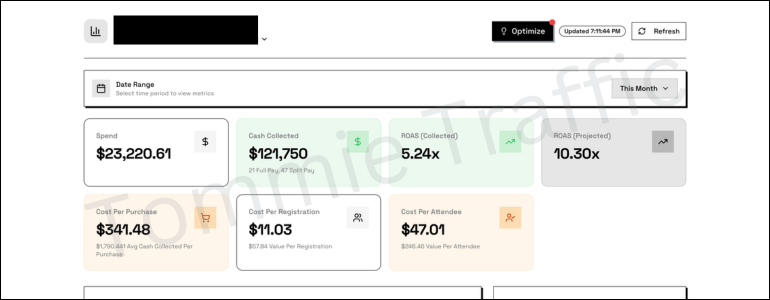
Playbook: Do This To Erase Wasted Spend With Paid Ads
With 18 years and over $140M in advertising under my belt, I’ve developed a data-driven approach to paid ads that I rarely see being utilized. So I want to share some of it with you today with the hopes that you’re inspired to look at what you’re currently doing through a new lens
Implementation Prerequisites
This system requires three conditions to function effectively:
- A well-defined offer with clear success metrics (even if estimated)
- A sales process that consistently converts new prospects
- A properly installed infrastructure to measure results
Without these prerequisites, your data will lack meaning and you won’t be able to measure what moves the needle in terms of true profitability.
But let me be upfront. This system is not a shortcut by any stretch of the imagination. Because the goal is for us to be able to clearly identify which variables actually impact outcomes versus those that create the illusion of progress.
The Problem With Most Ad Strategies
Most businesses approach paid ads with fragmented tactics instead of using a system that strategically aligns all the pieces of the puzzle.
They test creatives without understanding their audience, build funnels without aligning them to their sales process, or attempt to scale campaigns before establishing profitable unit economics.
The core issue isn’t insufficient budget or poor creative, it’s the absence of a systematic framework that bridges the gap between business outcomes and the buying journey of your ideal prospects.
What We Do Differently
After managing and consulting on thousands of ad accounts across multiple industries over the last 18 years, I began documenting both successful and unsuccessful ad campaigns.
As a result, I developed a unique system based on the patterns that emerged and what I found consistently were 5 key components that are REQUIRED to function interdependently:
- Conversion: the offer architecture and sales mechanism that transforms prospects into buyers
- Conversations: multi-touch nurture sequences that build trust throughout the buying journey
- Creatives: the messages that align with your ideal prospects based on documented audience language and pain points
- Campaigns: the strategic targeting that reaches your ideal prospects at the appropriate stage of awareness
- Congruence: the through line that ensures a positive experience from ad impression to post-purchase
I call this the “5C’s Framework” and it’s the foundation of my “AdProfit Playbook.” I’ve validated this system across B2B service providers, ecommerce brands, digital products businesses, software companies, etc with wide ranging revenues between $300K and $70M+.
What this framework does not focus on is creating a proven offer. This is why the minimum revenue is $300k per year, because generally at that stage there’s an offer that’s already working and prime for scale.
Without a working offer, you shouldn’t even be running ads anyway. So if you’re reading this and you don’t have an offer that’s already consistently selling, the rest of this is probably not very useful for you.
How To Install This Framework
With a proven offer and a sales process that’s working, the very first thing we do is what I call “Audience Intelligence.” The generic term most used in our industry is called “market research” however, we don’t just want research data. We want real true intelligence on our audience so that we can properly install the framework with congruence layered across every phase.
Just to give you an idea of our workflow, let me break down “Audience Intelligence” a little more so that it makes more sense.
First off, there’s 2 buckets we use: external and internal. External is research and insights we can collect from external sources. Internal is research and insights we can collect from the assets we own.
External intelligence sources can include:
- Analysis of competitors to extract customer language around objections and desired outcomes
- Forum mining (Reddit, Facebook groups) to identify recurring pain points that existing solutions fail to address
- Amazon review analysis to understand what customers are not getting from current market options
- Search query data revealing actual questions prospects ask before making purchase decisions
Internal intelligence sources can include:
- Purchase data showing timing patterns, upsell sequences, and repeat buyer behavior
- Support conversation analysis to document decision triggers and common objections
- Content engagement metrics identifying which topics and formats drive conversions
- Post-purchase surveys capturing exact language customers use to describe transformation
When collected and organized properly, this intelligence layer directly informs:
- Audience Targeting
- Creative Angles
- Conversation Sequences
- Conversion Mechanisms
This is how we eliminate the guesswork and waste that typically inflates customer acquisition costs.
Matching Conversion Systems To The Sales Process
Another really big factor is that this framework emphasizes alignment between funnel architecture, your sales process, and the natural buying behavior of the audience.
Just because a funnel is popular, doesn’t mean it’s the one we should be using. The least amount of friction for both the business and their ideal prospects is to align the funnel with the sales process, not “FORCE” a sales process to fit a funnel.
Every sales process doesn’t work for every business, so whatever is already working should be the main ingredient to determine what kind of funnel we want to have in place.
The other thing is that all prospects don’t buy the same way. So when we’re trying to scale, we find it easier to focus on what works for the business until we’ve tapped out what we can maximize AND THEN add on additional sales channels to meet the needs of the audience.
The way I relay this to my clients is that I tell them all the time…
“Let’s max out our strengths and scale into our weaknesses.”
At a high level, here’s how I think about most funnels and the best use cases based on the sales process:
- Traditional sales funnels work best for products and services where the value proposition is immediately clear. These use direct-response mechanisms (VSLs, sales letters) to convert cold traffic.
- Application funnels generate qualified leads for high-ticket offers requiring sales conversations. Success depends on robust nurture systems and pre-call content that establishes authority.
- Webinar/challenge funnels serve solution-aware prospects who need education before commitment. The webinar/challenge itself becomes the primary sales process and conversion mechanism.
- Self-liquidating offers recoup ad costs upfront through front-end products while building a buyer list for back-end offers where actual profit occurs.
Mismatching funnels to the sales process is one of the most common structural failures I see when auditing the advertising systems of my clients. But by following this framework, we can prevent this by optimizing the conversion system before we ever launch another campaign.
Optimization Is The Name Of The Game
Once we have our audience intelligence complete and we’ve made sure our funnel matches the sales process, all that’s left is to make sure our tracking is set up properly so that we can fire off campaigns.
But getting campaigns up and running is just the beginning. Optimization is “The Real Secret” to producing high performing ads that consistently perform well without wasting spend. This is the part where most businesses and agencies fail because it also requires a consistent commitment.
As a result, we developed our own customized process that we install for every project. It’s what I call our “Operating System” and it’s the engine behind the entire playbook we run.
Just to give you a quick sneak peek, here are the 3 key features:
- The “Master” is where we define our success metrics and our secondary metrics. Success metrics are the primary conversion actions that create momentum towards our primary goals. The secondary metrics are the leading indicators (KPIs) that tell us if we are headed in the right or wrong direction towards our success metrics. For example, a success metric might be a cost per lead of $10. And a secondary metric might be a cost per click of $2. Well if we know our lead page converts at 25%, then $5 per click is likely an indicator we’re not going to hit our success metric.
- The “Analyze” feature is where we track stats every single day. Let me say that again: EVERY SINGLE DAY. The point of this is because we’re looking for patterns to determine what’s working and what’s not based on our success metrics and secondary metrics. So the numbers we track daily only focus on the key metrics. One other thing is that we log this data every single day so that we always have a pulse on things. Yes you can automate this, but I make my team do it manually just make sure someone is evaluating the data every day even if it’s just for 5 minutes.
- The “Optimize” feature is where we record all the changes we make in an attempt to improve what we’re doing. What happens here is that over time we can clearly see what moved the needle and what did not, and the premise for why we tested something in the first place. Ultimately the goal is to do more of what’s working and stop doing the things that don’t. Which leads to stacking wins on top of wins, and that creates the momentum we need to scale.
By centralizing all of this into one system, it keeps us focused on the success metrics while eliminating the scattered spreadsheet approach that loses insights over time.
The Compounding Effect
The primary value of the 5Cs framework emerges over time. Each testing cycle produces documented insights that inform future decisions. Each audience intelligence report reveals language that improves next month’s creatives. Each conversion optimization lift we get raises the ceiling on how much we can profitably spend.
With our optimization process, we follow a systematic sequence across the 5Cs:
- Conversion optimization (pricing, packaging, guarantees, scarcity)
- Conversation optimization (follow-up sequences, SMS, outreach)
- Creative optimization (new angles, copy variations, asset testing)
- Campaign optimization (targeting, placements, device segmentation)
- Congruence optimization (tying the other 4 together across the journey)
Each optimization type is documented with before/after results, building an internal knowledge base that compounds over time.
This compounding effect is why businesses using my framework consistently outperform whatever they were doing beforehand. In many cases, my clients already come in with solid creatives, conversations, and conversion systems. What they were missing was a system that focuses on optimization while making sure the prospect journey is congruent.
If you’re currently investing in ads without a documented framework, the question is not whether to implement a system. The question is how much longer will you tolerate the results you’re getting before doing so?
So what I recommend you do next is to click here to watch my Free Presentation where I go deeper into the 5 Mistakes That Prevent Profitable Ads.
Then if you resonate with the message and would like to discuss how to implement the system into your business, you’ll be able to schedule an install.
P.S. If you’ve gotten value from this but not ready just yet, please help me spread the word! If you know any businesses that are already investing in ads that would love to get better results, send them this link. Then reach out to me via DM on social media and let me know. 😉
About the Author
